Why Every Event Needs a Solid Budget Before Anything Else
A practical event budget example covering categories, contingency, forecasting, and ROI tracking from kickoff to closeout.
Why Every Event Needs a Solid Budget Before Anything Else
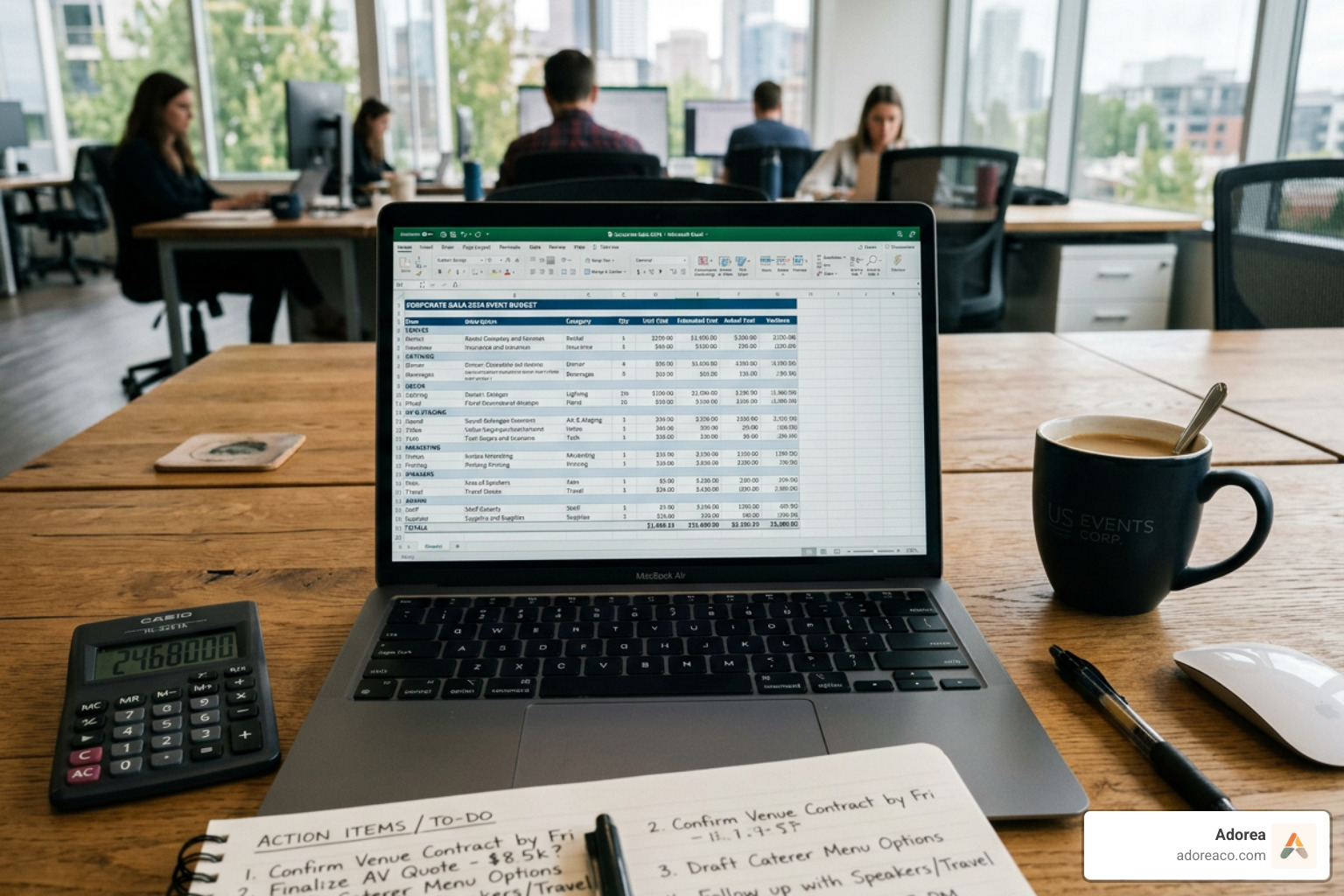
An event budget example can be the difference between a smooth, profitable event and a stressful financial mess. Before you book a single vendor or send one invitation, you need a clear picture of where every dollar is going and where it's coming from.
Here's a quick snapshot of what a basic event budget includes:
| Category | Typical % of Total Budget |
|---|---|
| Venue | 15-20% |
| Catering & F&B | 20-30% |
| A/V & Technology | 10-15% |
| Marketing & Promotion | 5-10% |
| Staffing & Labor | 10-15% |
| Entertainment & Speakers | 10-15% |
| Decor & Signage | 5-10% |
| Contingency Fund | 10-20% |
The numbers above are a starting point. Your actual split will depend on event type, size, and goals.
Here's why this matters right now: 3 out of 4 event planners admit to overspending on their last event. And with the cost per meeting attendee rising to an estimated $169 per day, there's very little room for guesswork.
Whether you're planning a corporate conference for 500 people or an intimate fundraiser gala, the same core principle applies a written budget is your financial blueprint. It keeps vendors accountable, stakeholders aligned, and your event financially viable from day one.
Over 80% of corporate event planners judge the success of an event based on how well it performed against the budget. That's not a coincidence. It's because budgeting is where good events are won or lost long before the first guest arrives.
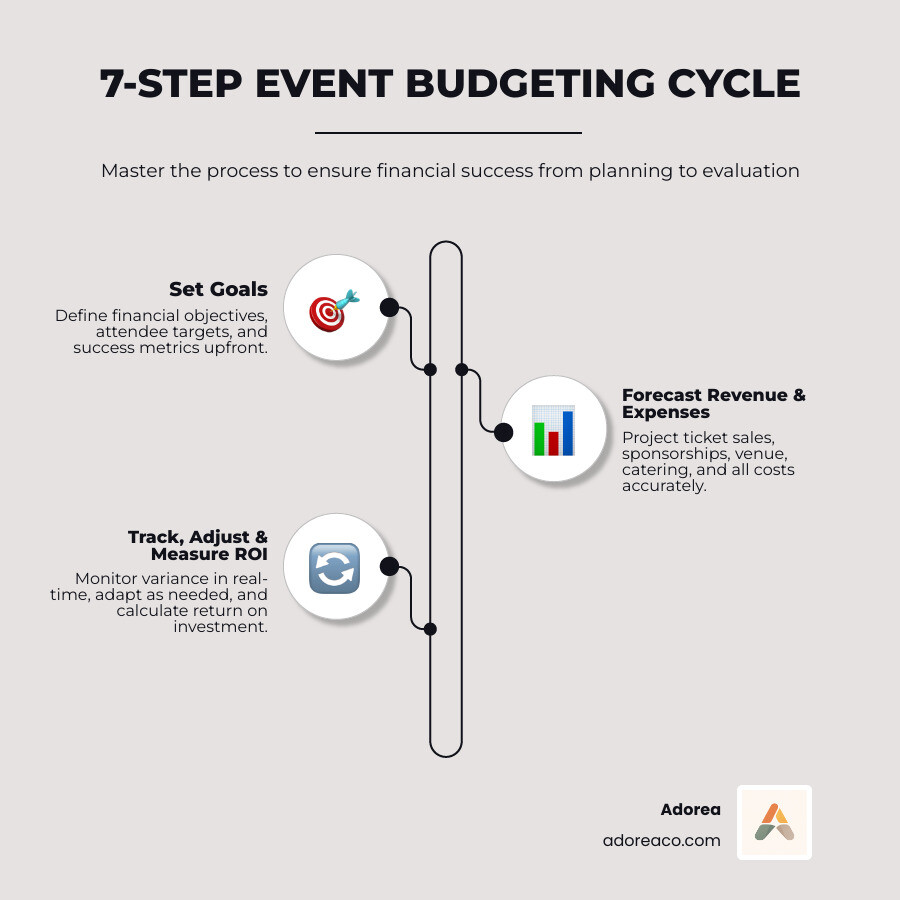
The Fundamentals of an Event Budget Example

When we talk about an event budget example, we aren't just looking at a list of costs. We are looking at a strategic document that proves the economic viability of your vision. Without this roadmap, costs can spiral in the blink of an eyemuch like a home renovation that suddenly uncovers "hidden" issues.
Setting Financial Goals
Before you input a single number, we recommend defining your financial objective. Are you aiming to turn a profit, break even, or is this a "loss leader" designed for brand awareness? For example, over 80% of corporate planners and 60% of non-corporate planners cite budget adherence as their primary metric for success. If your goal is profit, your revenue forecasting must be conservative, while your expense tracking must be surgical.
Cash Flow and Stakeholder Alignment
Managing an event budget isn't just about the final total; it's about cash flow. You need to know when deposits are due and when sponsorship checks will actually clear. A common mistake is having plenty of "projected" income but zero liquid cash to pay a venue deposit in month two. By sharing a clear event budget example with stakeholders early, you ensure everyone is aligned on what the event canand cannotafford.
Fixed vs. Variable Costs
To master your budget, you must distinguish between costs that stay the same regardless of attendance and those that fluctuate.
| Cost Type | Definition | Examples |
|---|---|---|
| Fixed Costs | Expenses that do not change based on the number of guests. | Venue rental, insurance, keynote speaker fees, basic A/V setup. |
| Variable Costs | Expenses that increase or decrease per attendee. | Catering (F&B), registration kits, printed nametags, gift bags. |
Categorizing Your Essential Event Expenses
To build an accurate event budget example, you need to deconstruct the event into logical categories.
Venue and Catering
The venue is often your largest fixed cost, while catering is usually the largest variable cost. In cities like Phoenix, Arizona or Miami, Florida, venue prices can peak during "season," so timing is everything. Catering typically accounts for 30-50% of a total budget. To keep this in check, consider alternatives like food truckswhich can cost between $8 and $30 per person compared to $125+ for formal plated dinners.
Technology and A/V
In the modern era, A/V is no longer just "a microphone and a screen." For hybrid events, you need a dedicated internet connection with at least 100mbps download and 30mbps upload speeds to support IMAG (Image Magnification) and streaming. Don't forget to check our guide on Questions to Ask Before Booking a Vendor to ensure your tech requirements are covered in the initial quote.
Marketing, Staffing, and Decor
- Marketing: Allocate 5-10% for social media ads, Google Ads, and PR.
- Staffing: 85% of planners use registration software to reduce manual labor costs.
- Decor: Lighting alone can transform a space but can be pricey. Uplighting a ballroom can cost up to $2,500.
Step-by-Step: Building Your Budget from Scratch
Creating a budget from a blank slate can feel like drowning in a sea of numbers. Follow this process to stay afloat.
1. Needs Assessment and Timeline
Start with the "big picture." How many people are attending? What is the core objective? Once you have the scope, you can Build a Calm Event Timeline. A rushed budget is usually an inaccurate one.
2. Revenue Forecasting
If your event isn't fully funded internally, you need to identify revenue sources:
- Ticket Sales: Create "Early Bird," "Standard," and "VIP" tiers.
- Sponsorships: Use a Sponsorship Strategy Guide to attract partners who can offset costs.
- Grants or Donations: Essential for nonprofit events.
3. Gathering Quotes
This is where many planners struggle. Why Getting Vendor Quotes for Events is Harder Than It Should Be often comes down to vague requirements. Be specific so you get an "apples-to-apples" comparison.
4. The Contingency Fund
Always, always set aside a "rainy day" fund. We recommend 10-20% of your total budget. This isn't for "extra" decor; it's for the $500 rush shipping fee you didn't see coming or the extra security guard the venue suddenly requires.
Real-World Event Budget Example for Different Occasions
Budgeting looks different depending on whether you are in a high-cost hub like New York City or a mid-sized market like Birmingham, Alabama. Scalability is keyyour budget should be able to flex if your 200-person seminar suddenly grows to 300.
One of the biggest hurdles is The Gap Between Event Planners and Vendors. Vendors want firm commitments; planners want flexibility. A good budget balances both.
Corporate Conference Event Budget Example
According to the 2025 Global Business Travel Forecast, costs are rising. The average internal meeting now costs roughly $554 per attendee per day when you factor in travel and lodging.
- Focus: Lead retrieval technology, multi-day logistics, and high-quality A/V.
- Break-even Analysis: If your fixed costs are $50,000 and your variable cost is $100 per person, and you charge $300 per ticket, you need 250 attendees just to break even.
Nonprofit and Social Event Budget Example
For fundraisers, the goal is maximizing the "Gift to Cost" ratio.
- Strategic Sourcing: Every pro needs a Reliable Wholesale Floral Supplier to keep decor costs down so more money goes to the cause.
- Volunteer Coordination: Use volunteers to offset labor costs, but remember to budget for their "thank you" meals and shirts!
Strategies for Cost-Cutting and ROI Optimization
You don't have to sacrifice quality to save money. Here are our favorite "pro" moves:
- Negotiate Early: Booking a venue 24-36 months in advance can lock in current rates and protect you from inflation.
- Go Digital: Swapping paper invitations for digital ones can save a wedding or gala up to $1,800.
- Off-Peak Booking: Hosting your event on a Tuesday or Wednesday in a city like Salt Lake City, Utah can slash venue fees by 30%.
- Analyze the Data: Post-event, look at your "Actual" vs. "Estimated" columns. Did you overspend on swag that people left behind? Use that data to cut the "fluff" from next year's budget.
Frequently Asked Questions about Event Budgeting
What are the most commonly overlooked expenses in an event budget?
Many planners forget about the "un-fun" numbers: taxes, service fees (often 20-24% at hotels), and gratuities. Other common misses include permits for outdoor spaces, insurance premiums, and "drayage"the cost of moving freight from a loading dock to your booth space.
How much should I actually set aside for a contingency fund?
A standard reserve is 10-15%, but if you are planning an outdoor event or using brand-new technology, push that to 20%. This fund protects you against inflation adjustments and last-minute emergency staffing needs.
How do I calculate the ROI of my event?
ROI (Return on Investment) isn't just about profit. Calculate it by taking (Total Revenue - Total Expenses) / Total Expenses x 100. However, also measure "soft" ROI: attendee satisfaction scores, social media engagement, and the number of high-quality leads generated.
Conclusion
At Adorea, we believe that financial transparency is the foundation of every great event. By using a solid event budget example and leveraging our marketplace efficiency to find the right vendors at the right price, you can eliminate the "math-induced" stress of planning.
Ready to turn your financial blueprint into a reality? Start planning your next event with confidence and let us help you connect with the vendors who fit your visionand your budget.